
By clicking a retailer link you consent to third-party cookies that track your onward journey. If you make a purchase, Smartme may receive an affiliate commission, which supports our server costs.
Add SmartMe as a preferred source.
Radio Teleswitch
27th June 2026 Cut Off - The service controlling Radio Teleswitch Meters (RTS) was turned off on the 27th June 2026 and customers will need to get a Smart Meter or lose their cheap rate service.
What is Radio Teleswitch (RTS)?
In the 1980s the Radio Teleswitch System (RTS) was introduced using a radio signal to switch on and off off-peak circuits such as those used in Economy 7 tariffs. This was usually used to heat up electric storage radiators and water during the night. Meters with RTS picked up a signal broadcast alongside the long wave signal for BBC Radio 4. England is covered by a signal transmitter at Droitwich constructed in 1934, with smaller transmitters at Westerglen and Burghead providing signal coverage for Scotland and Northern Ireland.
RTS was used to flatten the load curve at night by grouping load into smaller segments. Without this, expensive flexible generating plant would have been needed to meet peak demand.
A customer was put into one of fourteen groups for control purposes, each group switching at a different time. RTS could not control an individual customer separately. The RTS control box also randomly shifted the switching time for an individual customer so that the load for the group did not all come on at once.
The Energy Networks Association (ENA) were responsible for management of the service.
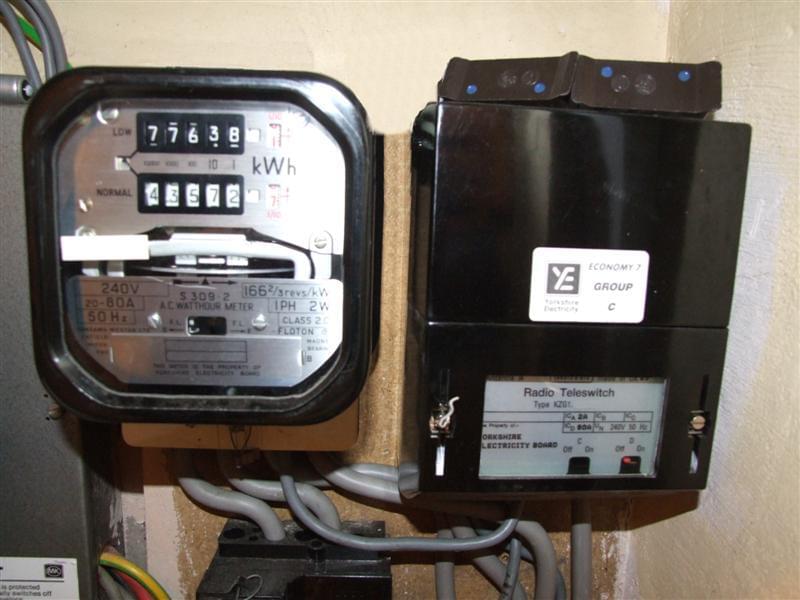
To facilitate this service usually an additional device would have been installed alongside the meter which would receive the Radio 4 long wave signal containing the switching instructions.
Where is RTS used?
The RTS system was introduced to support versions of multi-rate tariffs with certain functions such as switching between peak and off-peak rates or turning on heating or hot water.
RTS was used everywhere but is more common in particular areas for these two reasons:
- Medium and high-rise tower blocks as electric storage heating was seen as a safer heating option than gas
- Properties in areas which are not connected to the gas grid. This was mainly West and Central Wales, and large areas of Northern Scotland.
RTS Running Costs
Towards the end of its life the operational costs of running the RTS service almost doubled from £5 million per year to £9.7 million per year. Originally both suppliers and generators shared the costs of running the service but in 2025 it was decided that suppliers should pay the full cost as generators have no involvement in the RTS shutdown.
This acted as an incentive for suppliers to complete RTS meter replacements quickly, potentially enabling an earlier RTS signal switch-off.
RTS Shutdown
The BBC planned to turn off long wave transmission system on 30th June 2025, but this deadline was again cancelled, as it has been many times before, as suppliers still had too many customers left on the system.
The service controlling Radio Teleswitch Meters was finally turned off on the 27th June 2026.
Slow Replacement
Ofgem recognised that replacement of RTS meters was too slow when they established a task force of themselves, suppliers, Distribution Network Operators (DNOs), the government and Smart Energy GB in October 2024. The Taskforce is working with consumer groups, housing associations and others to reach the goal of upgrading all RTS meters in England, Scotland and Wales (Great Britain).
This has not been enough to improve replacement rates significantly and the government have been forced to act. In a written statement to the house of Commons on 18th June 2025 the Minister for Energy Consumers stated that there will be a managed and more controlled Radio Teleswitch Service (RTS) phase out from 30th June 2025. People with an RTS meter will not face any unexpected disruption to their heating or hot water at the end of June 2025.
Replacement progress is still slow as the chart and table below shows. In fact, bearing in mind the more difficult exchanges end up being left to last, it will take a few more years to replace all the RTS systems out there.
| Year Month | Number |
|---|---|
| 2026 Mar | 392,887 |
| 2026 Feb | 404,001 |
| 2026 Jan | 416,139 |
| 2025 Dec | 417,869 |
| 2025 Nov | 431,224 |
| 2025 Oct | 454,891 |
| 2025 Sep | 475,520 |
| 2025 Aug | 479,849 |
| 2025 Jul | 518,908 |
| 2025 Jun | 573,162 |
| 2025 May | 611,645 |
| 2025 Apr | 646,148 |
| 2025 Mar | 677,126 |
These figures were published monthly by Elexon, but unfortunately, they stopped publishing them in March 2026.
Why was RTS decommissioned?
RTS was decommissioned for the following reasons:
- The operational costs were £9.7M each year
- Smart Meter functionality can take over
- The BBC have moved onto digital technology and no longer use the equipment
- The old valve technology used for the RTS service has limited spares
- Long wave has low quality sound
- The old transmitters are energy intensive.
What is the impact?
Without the signal, the behaviour of meters with RTS is uncertain. Some may continue to switch between rates using stored settings while some may remain on whatever rate was in place when they last received a signal.
The impact is:
- your heating and hot water may be left continually on or off
- your electric storage heaters may charge at the wrong time of day, possibly leading to higher bills
- your supplier may be unable confirm your electricity usage during peak or off-peak times, and your electricity costs may be higher than before.
What is the solution?
The solution to the RTS Shutdown is for electricity suppliers to remove radio teleswitches and install a SMETS2 smart meter with a fifth terminal. The fifth terminal enables the heating to be switched on or off at standard fixed times of the day determined by your tariff, for example Economy 7 (E7).
Customers Should Decide Now
If you have RTS, your supplier will have written to you. We strongly advise customers to decide now what they want to do, that way you can take control of what happens. Our recommendation would be to ask for a Smart Meter as this is the only way to try to continue with a similar service to RTS.
Decide if you are happy to have a Smart Meter:
Yes: Ask your supplier to install a Smart Meter and tell them you would like to continue with your RTS tariff. Your supplier is likely to offer a similar tariff such as Economy 7 or Economy 10.
No: Your RTS service will fail when it is switched off, and you will move to a single rate tariff costing you more. You may also need to call in an electrician to make sure your off-peak circuits work as you would like, as they are likely to remain either on or off all the time.
Please do not put off this decision.
(Page updated: 2026-07-12)