
Add SmartMe as a preferred source.
What is a Time of Use Tariff and how does it work?
Time of Use (TOU) tariffs can be confusing. They sound complicated and it is hard to know if they are of benefit or will save a customer money. They have various names and aren't even identified as "Time of Use".
What is Time of Use?
A Time of Use tariff is a pricing structure where the cost of electricity varies depending on the time of day it is used. The price can even vary by week or month and season on more complicated tariffs.
A simple example that's been going for years is the Economy 7 tariff. Here's an example:
| Time Period | Start / End Time | Price per kWh |
|---|---|---|
| Night or Off-Peak Hours | 7 hours between 11pm and 6am | 8.65p/kWh |
| Day or Peak Hours | 17 hours between 6am and 11pm | 23.98p/kWh |
Even this looks complicated doesn't it.
The reason the tariff has to say 7 hours in a specified period is that suppliers don't want all the load coming at the same time, so they give different customers a slightly different start and end time for the cheaper rate.
Without this staggered starting, if all customers used a timer to switch loads on when the cheap rate started then the electricity generators would be put under strain to meet such a rapid increase in demand.
Why are Time of Use Tariffs used?
Time of Use tariffs apply to electricity only and not to gas; this is because gas can be stored and therefore is not sensitive to the demand for gas at a particular time.
Electricity, on the other hand, cannot be stored easily and therefore needs to be generated at the time it is needed. And if it is being generated when demand is high then more expensive type of generation is called into action such as gas power stations. This is because gas power gas stations can increase and decrease their generation output relatively quickly.
For this reason, electricity is priced for every half-hour in real time depending on the generation and demand at the time. So, each half hour has a different price, and this allows suppliers to offer Time of Use tariffs.
How do Suppliers work out Time of Use prices?
The chart below shows typical electricity prices over a day in June 2026 but the shape is typical of most days. You can see that morning prices peak at 06:30 and evening prices have a peak from 16:00 to 18:30.
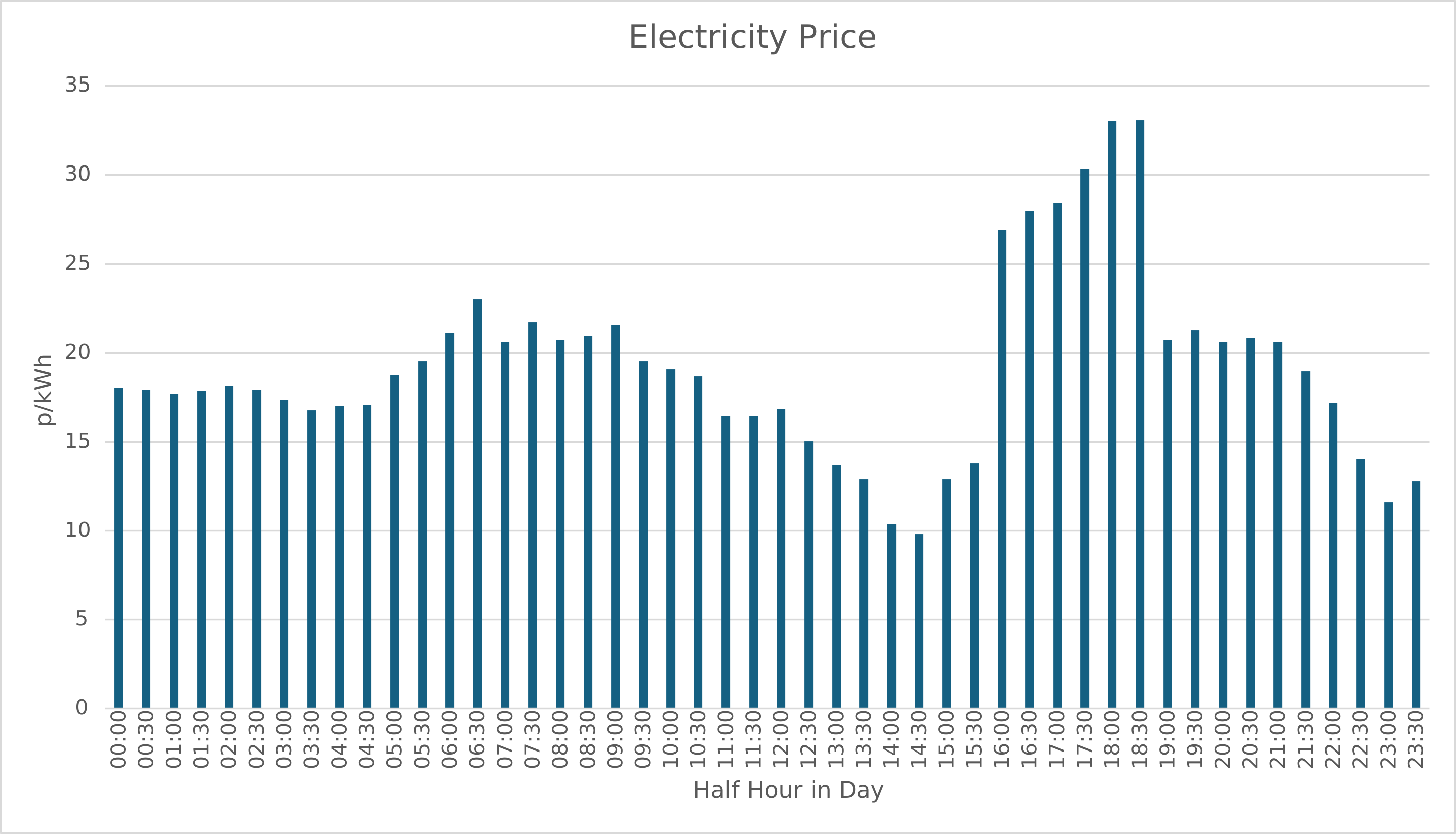
Suppliers look at their own forecast of costs of electricity for each half hour and set prices by averaging over the day for a normal single rate tariff. Suppliers' forecasts vary because they can buy electricity ahead of time in the trading markets and buy it on the day. Most suppliers try to buy the right volume of electricity ahead of time so that they know the price ahead of time.
If they want to create a Time of Use tariff, then they will average the prices over the appropriate time periods. So, for example, if they want to create a tariff with 2 time periods then they will average the prices over the 2 time periods and set the prices accordingly.
The most complex ToU tariff is one with a different price for each of the 48 half-hour periods in a day.
Can a Time of Use tariff save me money?
A Time of Use tariff will probably be more expensive unless you can shift some of your load from the higher rate period to the lower rates period.
For example, storage radiators which charge up by storing heat overnight are an ideal match with a two rate Economy 7 tariff - in fact they are the reason Economy 7 was invented.
What appliances could I use on a Time of Use tariff?
Although it takes some effort to set up shifting some load from day to night, once done it can be almost automatic. Examples of appliances that could be used at night are:
- Storage heaters
- Electric car chargers
- Hot water tank
- Dishwashers
- Washing machines
- All your other gadgets such as, phone chargers, laptop chargers, battery chargers.
What Time of Use tariffs are available?
Contact your electricity supplier to find out what Time of Use tariffs are available in your area.
Examples of common tariffs are:
- Economy 7 - 2 time periods with 7 hours of cheap rate at night
- Economy 10 - 2 time periods with 10 hours of cheap rate at night
- EV (Electric Vehicle) - 2 time periods with 7 hours of cheap rate at night
- Heat Pump - 3 time periods with two cheap rates from 4am - 7am and 1pm - 4pm
- Battery Storage - 2 time periods with a cheap rate at night to charge your solar battery
- Market Tracker - A different price for each half hour in the day following the electricity market price.
What to watch out for
One thing to watch out for is whether your time of use tariff times are GMT (Greenwich Mean Time) or BST (British Summer Time or Clocktime). Most tariffs use GMT so you may want to alter your timeswitches settings for appliances when the clocks change.
Ask your supplier or check your tariff terms and conditions to find out, as you don't want to switch your appliance on at the high rate when you expected the low rate.
(Page updated: 2026-08-24)